

 By
By Most e-commerce advertisers today are operating under a quiet, dangerous illusion—that automation has already figured everything out for them. The rise of Performance Max (PMAX) made it incredibly easy to believe that you could simply plug in your product feed, upload a few creative assets, and let the machine learning algorithm handle your business growth.
To be fair, PMAX does work. It delivers baseline results quickly, especially if you lack the time, resources, or deep platform expertise. But here is the uncomfortable truth most digital storefronts realize far too late:
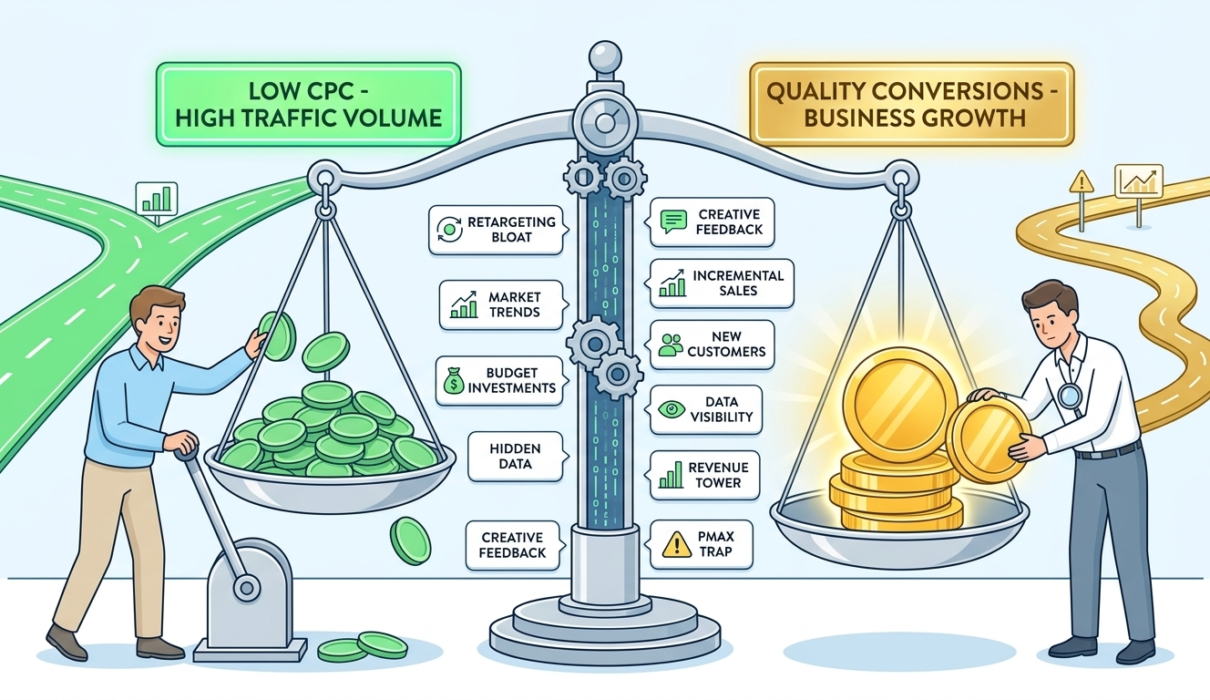
The PMAX Trap: Performance Max is not engineered to maximize your long-term business growth. It is designed to maximize efficiency strictly within its own algorithmic constraints.
The shift from an average advertiser to an advanced operator happens when you stop outsourcing your marketing strategy to automation and start rebuilding control intentionally.
Table of Contents
- 1. The Hidden Mechanics Under the Hood of PMAX
- 2. The 3-Layer System to Reclaim Control from Automation
- 3. Checklist: How to Audit Your PMAX Account Efficiency
- 4. The Hybrid Approach: Repositioning PMAX as a Safety Net
- The Ultimate Scale Insight
1. The Hidden Mechanics Under the Hood of PMAX
When you analyze how it behaves, Performance Max in Google Ads functions like a generalist. It spreads your ad spend across Google Shopping, Search, Display, Discover, and YouTube—doing a decent job everywhere, but mastering absolutely nothing.
While a large portion of your budget typically shifts toward Google Shopping, the catch is that this automated “multi-channel intelligence” leans heavily on retargeting and branded traffic.
This is where your marketing dashboard becomes highly misleading:
- Incredible ROAS: Your Return on Ad Spend looks amazing.
- Inflated Conversions: Your campaigns seem highly profitable.
- The Reality: The algorithm is quietly prioritizing the lowest-hanging fruit—people who already know your brand, have previously visited your site, or are already deep in your sales funnel.
You aren’t generating new customer acquisition; you are simply paying Google a premium to convert existing demand.
2. The 3-Layer System to Reclaim Control from Automation
To drive true, incremental scaling, high-performing e-commerce accounts break the automated functionality of PMAX into three focused, manual systems.
Layer 1: Advanced Shopping Campaign Structures
Products are not created equal. They have vastly different profit margins, conversion rates, and inventory cycles. Instead of letting Google treat your product feed as a single pool, you must dictate budget based on clear business logic.
Advanced marketers segment their product feeds into dedicated Standard Shopping or segmented asset groups based on performance tiers (e.g., Top Sellers, High Margin, Zombies/Underexposed). This transforms your ad spend from a blind pool into an intentional investment portfolio.
Layer 2: Reclaiming the Search Black Box
Inside PMAX, search traffic is a complete black box. You cannot easily see exact keyword-level data, you cannot control ad messaging precisely, and you have zero visibility into what search queries are driving real customer acquisition versus branded searches.
When you isolate search queries into standalone search campaigns, clarity replaces guesswork:
| Traffic Type | Funnel Role | Strategic Value |
| Brand Search | Defensive Catch-Net | Low Incremental Growth (Users already know you) |
| Non-Brand Search | Offensive Growth Engine | High Incremental Growth (New customer acquisition) |
Layer 3: Deliberate Demand Gen and Creative Testing
PMAX frequently uses your image and video assets for low-value retargeting on the Google Display Network. By isolating your top-of-funnel tracking into dedicated Demand Gen or YouTube campaigns, you can deliberately test narratives, hooks, formats, and audience segments. This builds a clean feedback loop that tells you exactly what creative messaging converts.
3. Checklist: How to Audit Your PMAX Account Efficiency
Before making major structural changes, use this quick checklist to determine if your Performance Max in Google Ads campaigns are masking inefficient spend:
- [ ] Check Brand Infiltration: Look at your search term insights. Is more than 20% of your PMAX conversion volume coming from variations of your own brand name?
- [ ] Audit Asset Group Completeness: Are you mixing generic text assets with specific product images, causing Google to serve mismatched, low-quality ads?
- [ ] Analyze Video Placements: Check where your video assets are serving. Are they spending budget on low-quality mobile gaming apps via the Display Network?
- [ ] Review Product Concentration: Look at your product report. Is 90% of your budget being hogged by just 1 or 2 products, leaving the rest of your catalog untested?
- [ ] Compare New vs. Returning Customers: Utilize Google’s new customer acquisition bidding to verify if your PMAX budget is heavily skewed toward historic buyers.
4. The Hybrid Approach: Repositioning PMAX as a Safety Net
The smartest advertisers operating in 2026 don’t completely eliminate automation. They reposition it.
Instead of treating Performance Max as your primary growth engine, scale it back into a strategic catch-all safety net.
[Offensive Manual Layer] ──> Non-Brand Search + Tiered Shopping + Demand Gen
                                   │
                                   ▼
[Defensive PMAX Layer]   ──> High-Target ROAS (Captures missed long-tail queries)
By removing your core product lines and keywords into controlled campaigns, and setting a significantly higher, strict Target ROAS (tROAS) on your remaining PMAX campaigns, you ensure the algorithm stops cannibalizing your organic or branded traffic. It runs quietly in the background, capturing unique, long-tail placements across the web without overspending.
The Ultimate Scale Insight
Automation in modern ad platforms is incredibly powerful, but it is never a replacement for creative marketing strategy. Automation scales whatever structure you build around it:
- If your foundational account structure is weak, automation rapidly scales inefficiency.
- If your foundational account structure is strong, automation scale-proofs your performance.
Reaching the next tier of e-commerce growth doesn’t come from completely handing over the keys to machine learning. It comes from knowing exactly when to take the wheel back.