

 By
By If you’ve spent any time running Google Ads campaigns, you’ve probably had this exact thought:
“My CPC is too high. I need to bring it down.”
It feels responsible. Efficient. Smart.
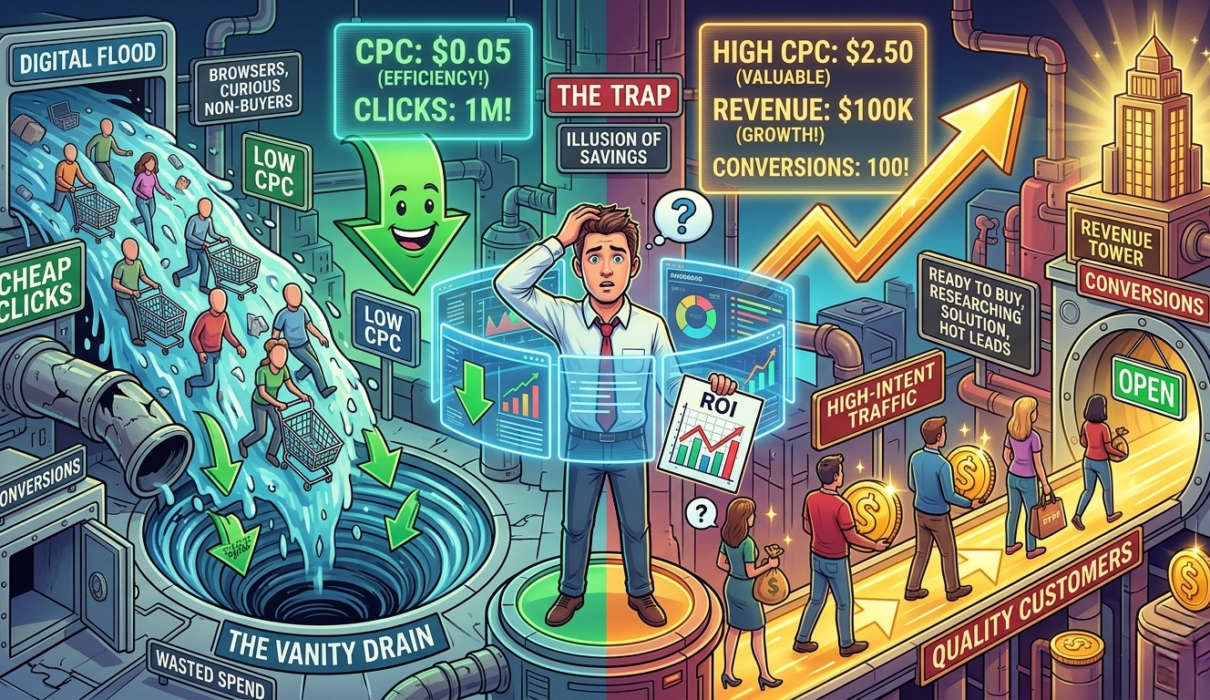
But here’s the uncomfortable truth that takes most marketers years—and thousands of rupees in wasted budget—to realize: Lowering your CPC can actually make your campaigns worse. Not slightly worse. Fundamentally broken.
Table of Contents
- 1. The Illusion of “Cheap Traffic” in Pay-Per-Click Advertising
- 2. Low CPC vs. High Intent: A Reality Check
- 3. Where Marketers Go Wrong: The Panic Loop
- 4. The “High-Intent” Google Ads Audit: A 5-Step Checklist
- 5. Shift Your Focus to Metrics That Actually Drive Growth
- 6. A Strategic Framework for Scaling Google Ads
- The Ultimate Scaling Insight
1. The Illusion of “Cheap Traffic” in Pay-Per-Click Advertising
When you first open your Google Ads dashboard, the Cost Per Click (CPC) is one of the easiest metrics to fixate on. It’s clean, it’s simple, and it gives you a comforting illusion of control.
The traditional logic seems flawless:
Lower CPC → Lower Cost → Better Marketing Performance
Except, that’s not how the Google Ads auction works. Google is not selling clicks. Google is selling intent. And high commercial intent is never cheap.
Decoding Search Intent: What Google Knows
Every time someone types a query into Google, there is a hidden layer of user psychology beneath it.
- Low Intent: A user searching “what is digital marketing” is just curious. They are researching, not buying.
- High Intent: A user searching “digital marketing course price” has a wallet in hand. They are ready to convert.
Google has analyzed billions of these search journeys. It knows exactly which searches turn into revenue, and it prices them accordingly. High-intent keywords feel expensive because they are inherently valuable. In any digital marketplace, high value drives higher competition, which drives up the price.
2. Low CPC vs. High Intent: A Reality Check
Let’s look at a simple math scenario to see how chasing a low cost per click actively harms your Return on Ad Spend (ROAS).
Imagine you are selling a premium digital marketing course worth ₹50,000.
Scenario A: The “Expensive” High-Intent Route
- CPC: ₹200
- Traffic: 10 clicks cost you ₹2,000 and bring in 1 lead.
- Conversion: 5 leads cost you ₹10,000 and result in 1 sale.
- The Result: You spent ₹10,000 to generate ₹50,000 in revenue. That ₹200 CPC suddenly looks incredibly profitable.
Scenario B: The “Cheap” Low-CPC Route
- CPC: You optimize to bring it down to ₹20.
- Traffic: Your traffic skyrockets, and your dashboard charts look amazing.
- Conversion: Clicks turn into zero sales because the traffic lacks buying intent.
- The Result: You didn’t optimize your campaign; you just changed your audience from buyers to browsers.
| Metric | Scenario A (High Intent) | Scenario B (Low CPC Trap) |
| Average CPC | ₹200 | ₹20 |
| Ad Spend | ₹10,000 | ₹10,000 |
| Clicks Received | 50 | 500 |
| Sales Closed | 1 | 0 |
| Total Revenue | ₹50,000 | ₹0 |
3. Where Marketers Go Wrong: The Panic Loop
The moment average CPCs start rising, panic sets in. To fight the rising costs, advertisers often make fatal “optimizations”:
- They loosen keyword match types (shifting from Exact to Broad match).
- They add generic, top-of-funnel keywords.
- They hunt for cheap, low-competition alternatives in Google Keyword Planner.
Slowly, the campaign drifts away from high-intent traffic. At first, the metrics look positive: CPC drops and clicks increase. It feels like progress until you check your actual business revenue. That’s when the real damage shows up.
The Reality of Modern Advertising: CPC is not a metric you fully control. It is dictated by market competition, consumer demand, and historical conversion data. Trying to fight rising CPCs in a mature market is like trying to negotiate rent in a city where demand is skyrocketing. You might win a few small battles, but you won’t change the macroeconomic trend.
4. The “High-Intent” Google Ads Audit: A 5-Step Checklist
To make sure you aren’t accidentally killing your conversions in pursuit of cheap clicks, use this quick checklist to audit your account strategy. This framework ensures your budget goes toward buyers, not browsers.
- 1. Review Search Terms Report Weekly: Identify and add negative keywords for informational queries (like “free,” “what is,” or “samples”) that drive down your CPC but fail to convert.
- 2. Audit Keyword Match Types: Ensure your core budget is allocated to Phrase and Exact match keywords. Avoid relying heavily on Broad match unless you have a massive budget and deep smart-bidding data.
- 3. Track Value, Not Volatility: Stop judging a keyword’s success by its individual cost. Group your keywords by their Cost Per Acquisition (CPA) and conversion value rather than their standalone CPC.
- 4. Maximize Impression Share on Winning Terms: Identify the top 20% of your keywords that drive 80% of your sales. Ensure their Search Impression Share is above 70%, even if their CPC climbs.
- 5. Align Ads with Landing Page Intent: Make sure the specific promise made in your ad copy matches the exact landing page offer. A seamless transition prevents costly bounces from high-CPC traffic.
5. Shift Your Focus to Metrics That Actually Drive Growth
The advertisers who win at scale do not obsess over front-end metrics like CPC. Instead, they obsess over what happens after the click.
To build a high-converting Google Ads strategy, start asking better questions:
- Are my leads actually converting into paying customers?
- Is my landing page optimized to convert high-value traffic?
- Am I targeting the correct stage of the buyer’s funnel?
- How can I improve my conversion rate to offset ad costs?
Here is the leverage point most marketers miss: If your landing page conversion rate improves, your effective acquisition cost drops—even if your CPC stays exactly the same or increases.
6. A Strategic Framework for Scaling Google Ads
Instead of fighting the algorithm to force a lower CPC, build a system that can afford expensive traffic.
Build a Balanced Keyword Portfolio
Do not rely entirely on one keyword type. Balance your account with an intentional mix:
- Bottom-of-Funnel (BoFu): High-intent, high-CPC keywords that close sales immediately.
- Middle-of-Funnel (MoFu): Supporting queries that carry strong intent but face less competition.
Invest Heavily in Conversion Rate Optimization (CRO)
If your website converts traffic at 4% while your competitor’s site converts at 2%, you can afford to bid twice as much per click as they can. Out-converting your competition allows you to systematically out-bid them and dominate the search results page.
The Ultimate Scaling Insight
True business scaling does not come from minimizing costs; it comes from maximizing output.
You can focus on reducing your Cost Per Lead (CPL) from ₹500 to ₹400 to save a small fraction of your budget. Or, you can focus on scaling your total leads from 100 to 400—even if your CPL rises slightly—and completely multiply your bottom-line revenue. One is minor budget optimization. One is aggressive business growth.
Always remember this golden rule of digital marketing: A ₹200 click that converts is infinitely cheaper than a ₹20 click that doesn’t.
Stop chasing cheap traffic. Start buying high-value intent.