

 By
By There’s a quiet shift happening in modern e-commerce—and most digital entrepreneurs are still looking in the wrong direction.
They’re obsessing over saturated online marketplaces, short-term hacks, and fleeting product trends. Meanwhile, a different class of elite operators is executing a far more strategic digital commerce strategy. They are building distribution channels they actually own and control.
That is the essence of the D2C business model. Direct-to-consumer commerce isn’t just a trendy alternative to traditional retail or standard e-commerce setups—it is the ultimate power move for sustainable brand equity. Once you understand the structural mechanics behind this shift, everything about modern digital retail and online consumer behavior starts to click.
Table of Contents
- What Is the D2C Business Model?
- D2C vs E-commerce Marketplaces: The Real Difference
- Why D2C Brands Are Outperforming Everyone Else
- The Hidden Engine: Performance Marketing
- The Power of Owning Data (And Why It Changes Everything)
- Manufacturing Control vs Trading: The Make-or-Break Factor
- Margins, Costs, and the Truth Nobody Tells You
- Why D2C Is a Testing Machine
What Is the D2C Business Model?
Strip away the corporate jargon, the confusing tech stacks, and the overcomplicated frameworks, and the fundamental definition of the D2C business model is aggressively simple.
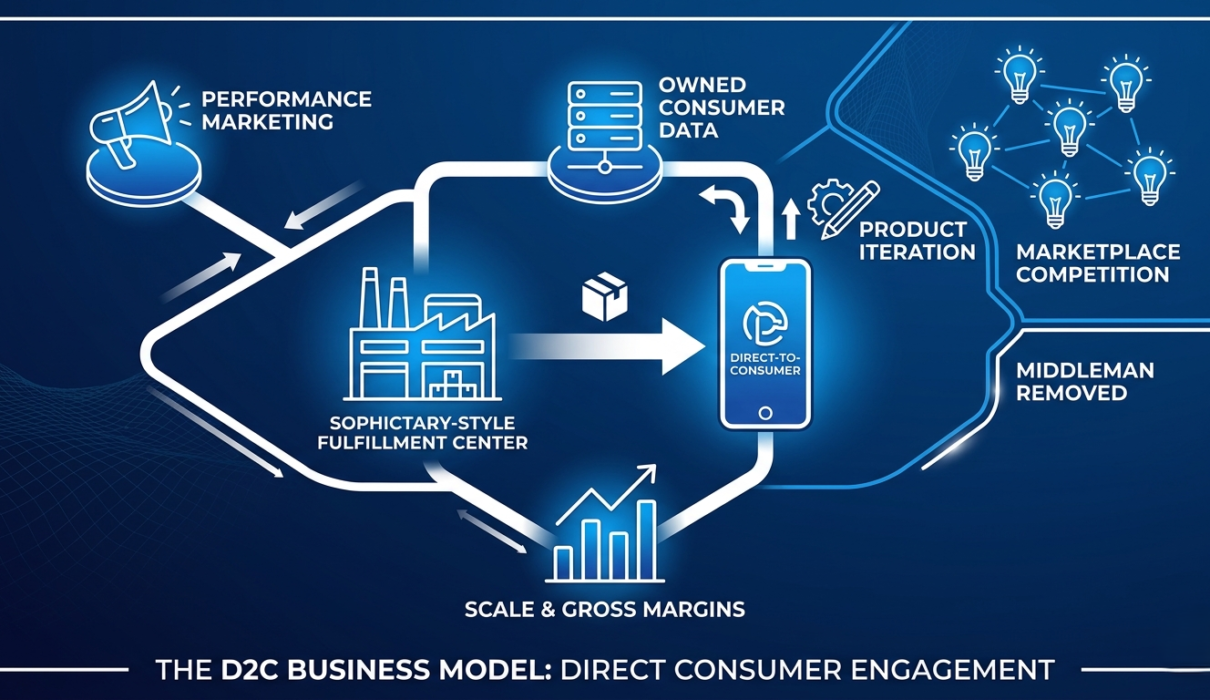
A direct-to-consumer brand manufactures its own inventory, builds a proprietary digital storefront, drives targeted traffic, and sells directly to the end consumer.
There are no wholesale distributors stepping in to dilute your message. There are no traditional retail storefronts taking a massive cut of your profits. There is zero dependency on third-party digital platforms deciding the fate of your business overnight.
By utilizing a direct-to-consumer channel, you deliberately remove the middle layers of the traditional supply chain. In doing so, you reclaim absolute operational control. What most beginners underestimate is how profound this structural autonomy really is. The exact moment you transition from a standard online reseller to a direct brand, you stop merely selling a product. You begin designing a cohesive, end-to-end customer experience.
D2C vs E-commerce Marketplaces: The Real Difference
This is where the industry confusion usually starts, and achieving absolute clarity here is what gives smart operators a massive competitive edge.
Selling inventory on massive multi-vendor platforms like Amazon or Flipkart is technically a form of e-commerce, but it is absolutely not D2C in its purest form. On a third-party marketplace, your brand is merely one of millions. You are locked in a relentless, exhausting competition for search visibility, ad clicks, and buy-box price positioning. The overarching platform entirely owns the customer relationship and the transaction history. In reality, you are just renting their audience attention.
The direct-to-consumer framework completely flips that flawed dynamic.
When you build a true D2C brand, your proprietary website serves as the ultimate digital storefront. Your unique brand identity becomes the ecosystem. Your customized conversion funnel dictates the entire consumer journey. You no longer forced to compete inside someone else’s rigid game—you define the rules of your own ecosystem. That shift might look subtle on the surface, but structurally, it is a massive evolutionary leap in retail.
Why D2C Brands Are Outperforming Everyone Else
The inherent advantage of this model does not stem from a single standalone feature. Instead, it is the result of a powerful combination of compounding operational edges.
When you manage a direct selling channel, customer feedback loops are never filtered, delayed, or obscured by intermediaries. The behavioral data hits your product development team raw and fast. Consumers tell you exactly what features they love, what they hate, and what they expect from your next product drop. The agile brands that respond to these direct signals quickly start pulling ahead of traditional retailers at an accelerating pace.
At the exact same time, you are no longer boxed into the rigid, uninspiring design templates of massive online marketplaces. You maintain total creative control over how your product is positioned, how your brand story is narrated, and how the unboxing experience is felt. That creative freedom directly translates into sharper emotional storytelling and vastly tighter conversion paths.
There is also the common gross margin narrative, which gets thrown around carelessly in e-commerce circles. Yes, bypassing wholesale distributors inherently improves your gross margins per unit. But that is only half the economic story—and honestly, it is the less interesting half. The real structural advantage isn’t just keeping a higher percentage of cash per transaction. The real leverage lies in deciding exactly where that reclaimed margin gets reinvested next.
The Hidden Engine: Performance Marketing
Here is the precise inflection point where most direct e-commerce journeys either accelerate into hyper-growth or completely collapse.
A beautifully designed website without high-intent traffic is a dead digital asset. In the highly competitive early stages of launching a brand, you simply do not have the luxury of waiting years for organic search engine optimization to kick in. SEO takes time to mature, and organic social media reach is notoriously inconsistent.
To break through the digital noise, you must buy targeted consumer attention. You do this through paid advertising channels, hyper-targeted social media campaigns, and relentless conversion rate optimization experiments.
This is the world of performance marketing—and within the D2C framework, it is not an optional marketing tactic. It is the core customer acquisition engine that gets the entire business model moving.
The elite brands that scale successfully treat paid acquisition ads not as an annoying business expense, but as a premium data collection system. Every single ad campaign tells you something valuable about your target demographic. Every click, every cost-per-acquisition metric, every checkout drop-off point—it is all actionable operational data. And that data is where your compounding momentum builds.
The Power of Owning Data (And Why It Changes Everything)
If you are looking for the single most compelling reason why direct-to-consumer e-commerce is such a dominant business model, this is it: you possess absolute data ownership.
You do not own the consumer data partially or indirectly. You own it completely.
Your analytics dashboard shows you exactly how real users behave on your site, where they hesitate during the checkout flow, what specific copy hooks they respond to, and what exact value proposition ultimately pushes them to purchase. Over time, distinct consumer purchasing patterns emerge.
You gradually start predicting profitable outcomes instead of merely reacting to marketplace changes. Once your brand reaches that level of analytical maturity, scaling your online sales stops being a game of emotional guesswork. It transforms into a predictable, repeatable system.
Third-party marketplace sellers rarely, if ever, achieve this level of operational clarity. Their visibility into consumer behavior is highly limited, fragmented, and intentionally obscured by the host platform. In a true D2C setup, the data feedback loop belongs entirely to you.
Manufacturing Control vs Trading: The Make-or-Break Factor
This is the invisible line that most aspiring e-commerce entrepreneurs do not even realize they have crossed.
They mistakenly think they are building a sustainable direct-to-consumer brand, when in reality, they are just engaged in basic commodity trading. They are simply buying a mass-produced product from a generic supplier at one price, listing it online at a minor markup, and hoping market demand sustains itself without any product differentiation.
The fatal flaw with that approach? You have zero supply chain control.
If the generic product underperforms or quality drops, your brand reputation takes the hit. If customers complain about a design flaw, you have to pivot completely away because you can’t fix it. There is no depth, no product iteration, and absolutely no economic defensibility.
True D2C brands operate on a completely different level of the supply chain. You either manufacture the goods in-house or tightly control the contract manufacturing production lines. You actively listen to direct customer feedback and refine the product formulation or design instead of abandoning the SKU. That native ability to iterate rapidly on the physical product itself—and not just changing the marketing angles—is exactly where real, generational brand equity is built.
Margins, Costs, and the Truth Nobody Tells You
Despite the glamorous case studies floating around the internet, there is a dangerous misconception that direct e-commerce is an effortless, high-margin shortcut to wealth.
It is absolutely not.
Yes, you successfully eliminate traditional retail middlemen. But you do not magically eliminate their associated operational costs—you simply redistribute them across your balance sheet.
Your digital marketing spend and customer acquisition costs (CAC) become highly significant line items. Intricate logistics networks, complex product return pipelines, localized customer support teams, custom packaging materials, and baseline operational overhead all stack up incredibly fast. Furthermore, in rapidly developing e-commerce markets, high Return-to-Origin (RTO) rates on cash-on-delivery orders can completely wreck your unit economics if your logistics stack isn’t highly optimized.
Therefore, the real game of sustainable e-commerce isn’t just boasting about high gross margins. The real game is how efficiently you can acquire a customer at scale, and how effectively you can maximize customer lifetime value (LTV) through retention marketing after that first sale. If your acquisition costs spiral out of control, the entire business model breaks. If you tightly control your CAC and drive strong repeat purchase behavior, the model scales beautifully.
Why D2C Is a Testing Machine
This is where the operational dynamics get incredibly exciting—and where most of your long-term business upside actually lives.
The direct-to-consumer model gives your business unprecedented operational speed. You can test new product concepts, ad creatives, promotional offers, and brand positioning angles at a frantic pace that traditional retail supply chains simply cannot dream of matching.
You launch a targeted digital campaign, read the real-time data signals, adjust your landing page design, and relaunch within hours. You do this over and over again. The modern e-commerce brand that iterates the fastest inevitably finds the winning, high-margin formula first. That is the ultimate strategic advantage of digital commerce. It is not just about the convenience of selling direct—it is about the compounding power of learning direct.
Final Thought
Operating a successful D2C brand is not an easier path than traditional wholesale commerce. In fact, it is significantly more demanding.
You are choosing to take on the massive operational responsibilities that various intermediaries used to handle for a fee. You must masterfully manage the entire customer lifecycle—all the way from initial digital acquisition to final-mile delivery and long-term brand retention.
But in return for taking on that operational complexity, you gain the single most valuable asset in modern business: absolute control.
You earn total control over your brand narrative, your unit economics, your proprietary customer data, and your long-term corporate future. In a volatile global market where digital attention is rented and centralized platforms constantly rewrite the rules of the game, true operational control is the only real leverage an e-commerce brand has left.